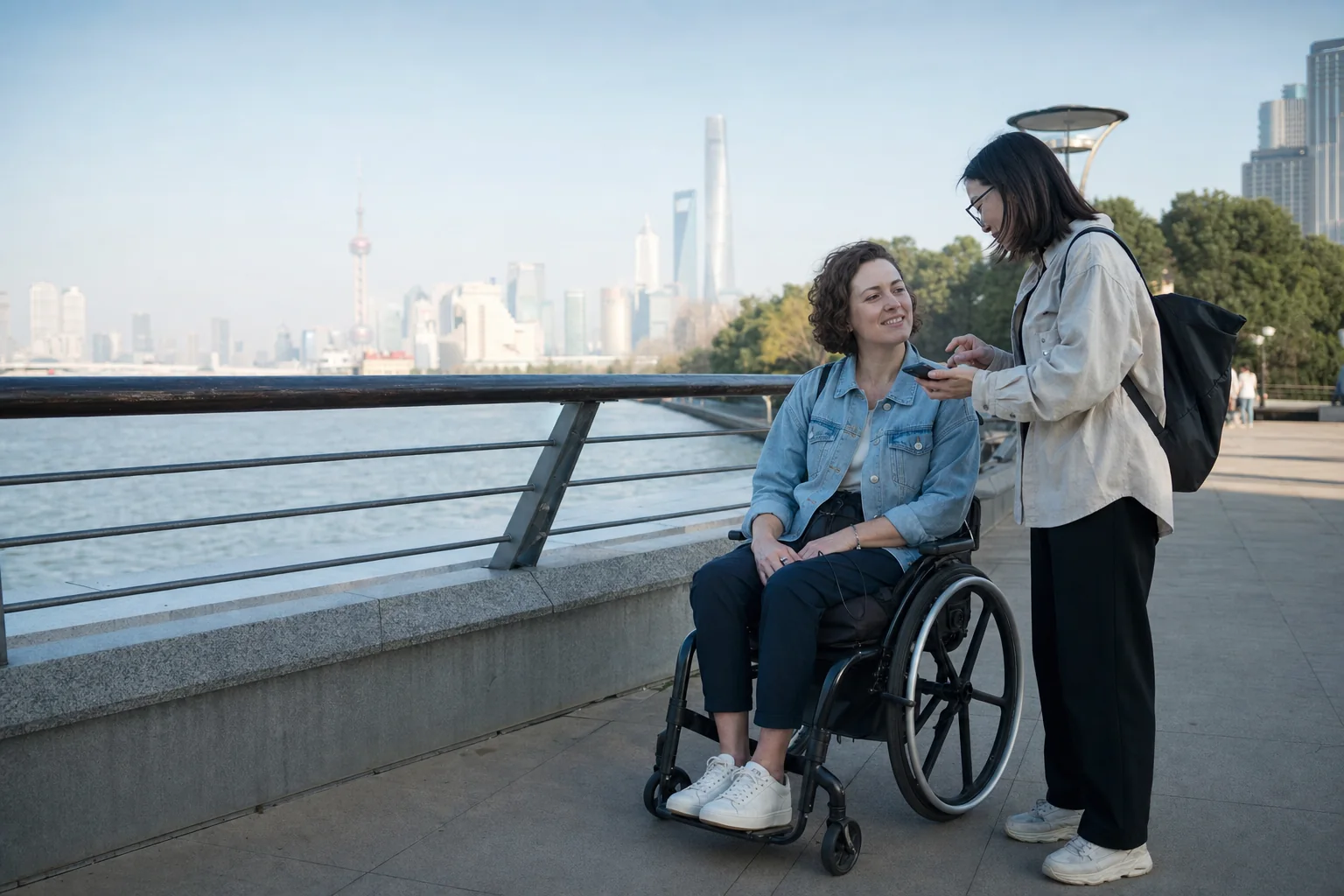
Accessible travel in Shanghai starts with details, not a label
Shanghai has continued to improve accessible public infrastructure, but “accessible” is not a single yes-or-no answer for an entire city. A hotel may have a lift but not the shower layout you need. A metro station may have elevators while the most convenient exit or the pavement beyond it is less straightforward. A museum may welcome wheelchairs while a special exhibition, a security route or a vehicle pickup uses a different entrance. The useful plan identifies the exact journey your group will make, then checks the parts that matter to you.
Shanghai’s accessibility regulations require public transport hubs and rail-transit stations to be accessible between ground level, station halls and transfer stations, and they set out broader standards for accessible services. That is a strong direction of travel, not a reason to promise a friction-free route at every street, older lane or venue. Elevators can be maintained, entrances can change and construction or crowd management can alter the practical route on the day.
Begin by describing the traveler rather than choosing an attraction list: manual or powered wheelchair, folded dimensions and weight, whether a companion helps, transfer ability, comfortable continuous rolling or walking time, need for accessible toilet access, step tolerance, seating breaks, medical equipment and whether you need an accessible shower. Specific facts turn a vague “easy day” into a route someone can genuinely use.
- Confirm every hotel room feature you need in writing for the booked room type.
- Check the actual entrance, lift and accessible toilet route—not only the venue name.
- Plan one compact district at a time, with a seated meal and a clear earlier finish option.
- Keep a practical vehicle meeting point rather than expecting door-to-door access on every pedestrian street.
Choose the hotel by the route from car to shower
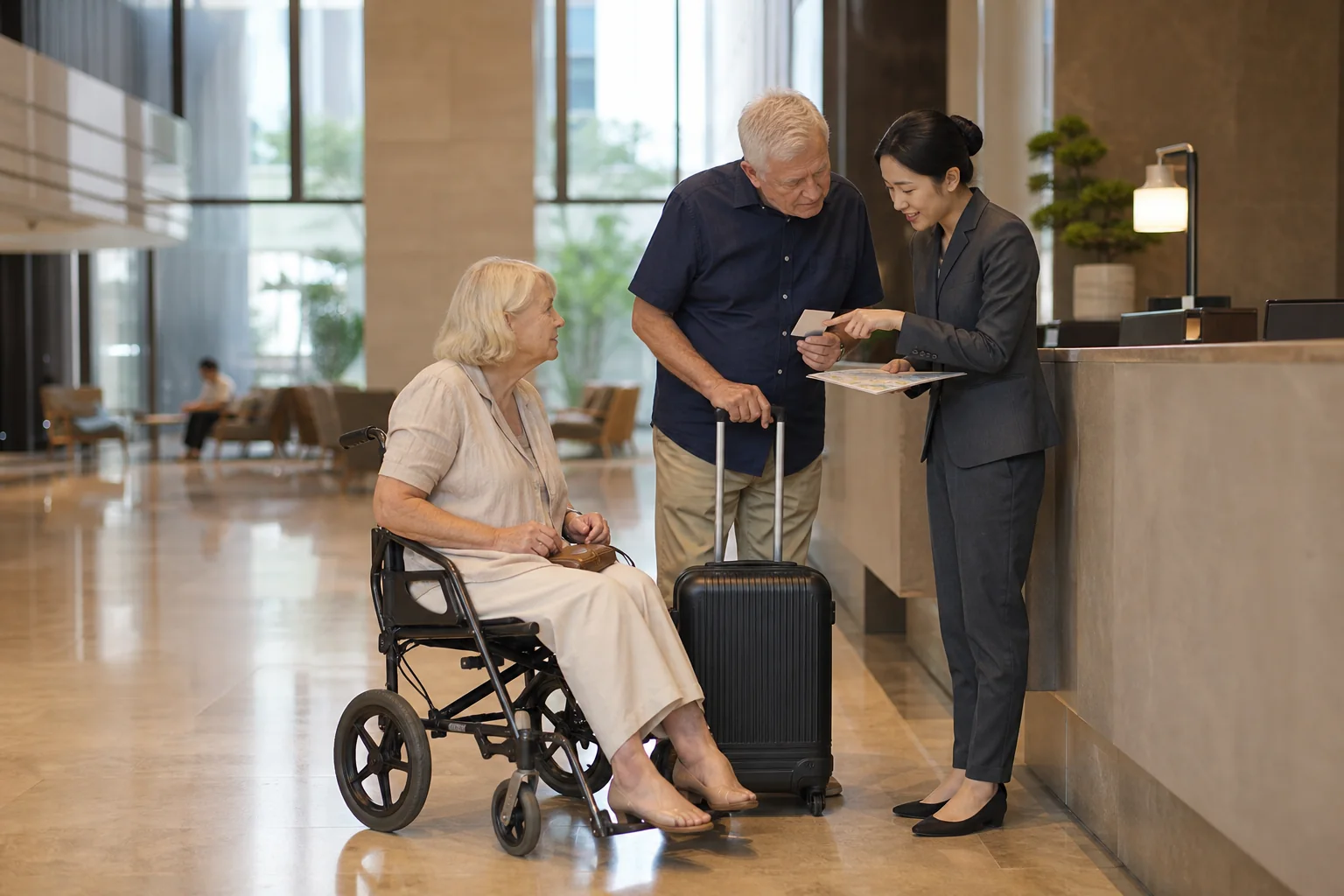
Ask the property or booking channel about the entire sequence: curbside drop-off, any incline or step at the entrance, automatic or assisted doors, lobby-to-lift distance, lift dimensions if critical, corridor turns, room-door width, bed height, bathroom threshold, shower entry, shower seat availability, grab bars and the location of an accessible toilet in public areas. A room described as “accessible” may still differ in layout from another room in the same hotel.
For a first visit, a central Puxi base or an area matched to the days you plan can reduce avoidable transfers. The Bund corridor, People’s Square, Jing’an, the former French Concession and Pudong all have different route logic. Choose the district that supports the hotel-to-first-stop movement and your evening return, then compare properties. A lower rate far from the daily route can cost more energy than it saves.
Send the hotel your arrival time and any need for an early room, luggage handling or a quiet check-in process, but do not assume those requests are guaranteed. If the room layout is a non-negotiable need, request confirmation before payment under a restrictive rate. Keep the property’s Chinese address and an agreed entrance note available for the driver or ride-hailing pickup.
Airport arrival: arrange the assistance and vehicle separately
Pudong and Hongqiao airports both have airport-controlled assistance arrangements. Shanghai’s official visitor guidance notes wheelchair assistance, accessible toilets, ramps, elevators and dedicated lanes as available facilities, while also advising travelers to check a specific location before visiting. Contact the airline early for any airline-controlled wheelchair or boarding assistance, and give the exact flight, date, connection, mobility-device details and transfer needs. An airport vehicle booking does not automatically include airside or airline assistance.
For the ground transfer, confirm passenger count, every large case, cabin bag, wheelchair type, whether it folds, powered-battery requirements where relevant, child-seat needs and the hotel’s workable entrance. The driver should meet you at a lawful, confirmed point—not a vaguely promised curb. If the wheelchair remains assembled, a vehicle that fits people but not the equipment is not a workable solution.
Protect the first day. Immigration, baggage and airport-to-hotel movement can take more energy than an itinerary template allows. Plan a light nearby meal, a hotel rest and perhaps one short, weather-appropriate view instead of a citywide circuit. A rested second day is more valuable than proving that you reached every landmark immediately after a long flight.
Metro, taxis and private cars: choose the least fragile connection
The metro can be useful for travelers with a confirmed step-free station route, light equipment and enough time for lifts and transfers. Shanghai’s regulations call for accessible connections at transit hubs and rail stations, and the city continues to expand ramps, elevators and accessible facilities. But use a station-specific plan: check the correct exit, expected lift route, transfer length and the path from street to venue. Do not assume the exit closest on a map is the easiest physical route.
A taxi or private car can reduce transfer fatigue, especially with an occupied wheelchair, luggage, rain or a fixed evening commitment. It does not eliminate all rolling or walking. Historic lanes, river promenades, garden entries and pedestrianized areas may require a legal drop-off some distance from the exact sight. Agree the pickup point before leaving the vehicle, save it on the phone and give the group a simple rule for a changed plan.
For a car request, send mobility equipment dimensions, whether the traveler can transfer independently, number of companions, luggage and desired pace. Ask only for what needs confirmation: suitable vehicle space, driver meeting point and service hours. Do not rely on general language such as “wheelchair-friendly car” without understanding whether the chair travels folded, secured or with the traveler seated in it.
Build a good city day around one accessible anchor
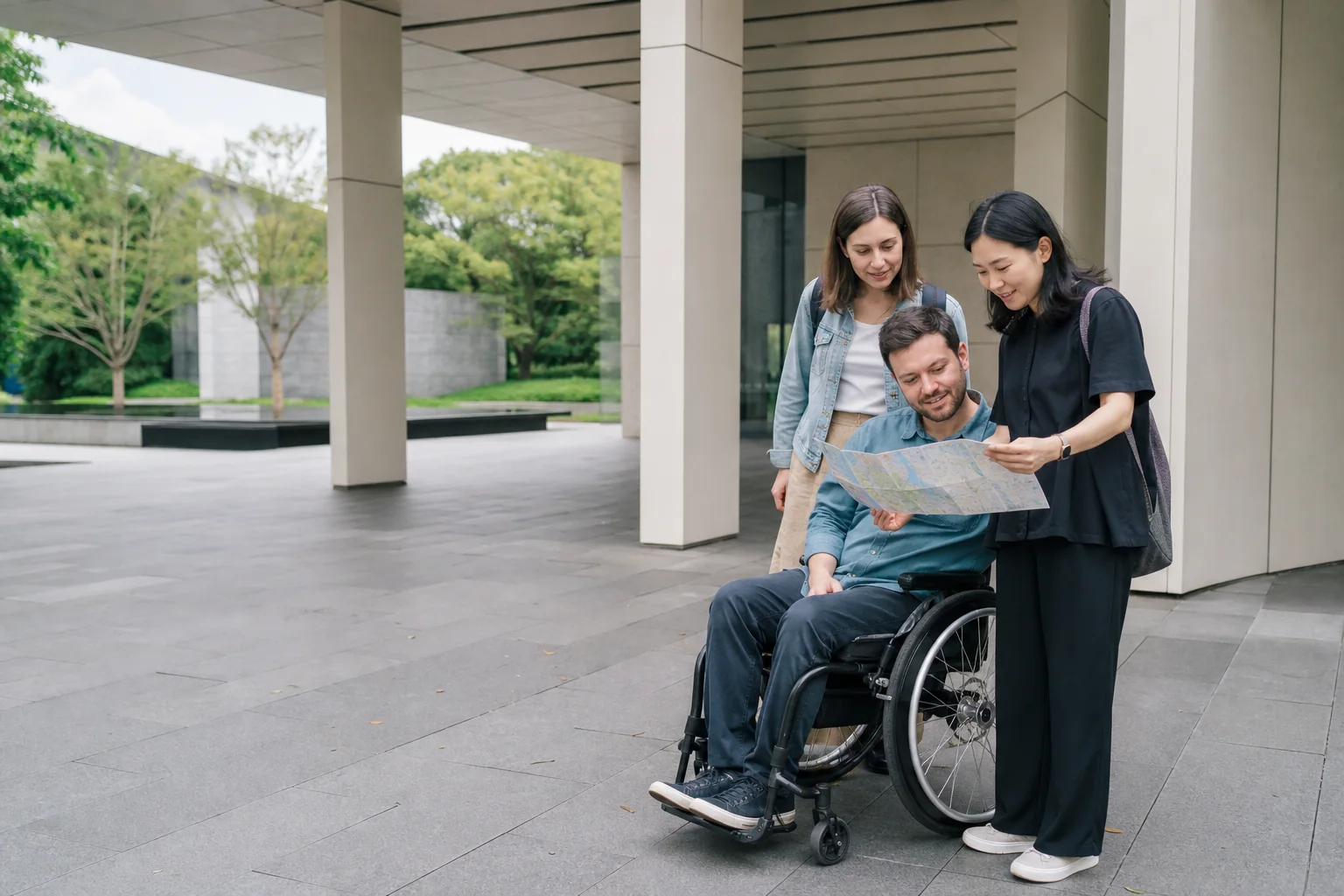
Choose one anchor that you can check closely: a museum, a waterfront section, a neighborhood meal, a gallery or a hotel-based afternoon tea. Then add only stops in the same practical area. The most satisfying accessible day is rarely a compressed version of a standard sightseeing route. It is a route with enough time to find the correct entrance, use the toilet, wait for a lift, pause in shade or return early without feeling that the day has failed.
Contemporary museums and newer public spaces can be easier starting points than an old-town circuit, but check the current visitor page for the specific entrance, reservations, security, elevator and accessible toilet information. Museums can change exhibition layouts and special-event procedures. If a location is essential, contact it close to the date; if it is optional, have a nearby seated alternative.
The Bund and riverfront views can be rewarding when you choose one manageable stretch and avoid turning the promenade into a marathon. Older neighborhoods and water towns have strong character but also more uneven paving, slopes, bridge approaches and crowded pedestrian lanes. They may be right for some travelers and the wrong choice for others. Honest route design respects that difference instead of labeling every historic setting accessible.
Food, toilets, weather and fatigue belong in the plan
Choose meal stops for more than cuisine. A good accessible lunch has a practical entrance, space to turn or park equipment, a real toilet plan, suitable seating and enough time to reset. A famous restaurant reached by a narrow stair or a long pavement detour may not be worth the stress. Tell the planner about allergies, medication timing, dietary needs and whether a quiet or early meal is important.
Heat, heavy rain and winter damp can materially change a route. A smooth-looking pavement can become tiring or slippery; umbrellas can make a busy promenade difficult; a lift wait can feel much longer at the end of a long day. Carry water, batteries, a light weather layer and a simple backup route. Do not make the itinerary dependent on one outdoor photograph or one distant dinner reservation.
Plan rest proactively. A seated break is not wasted time, and ending after one excellent museum or riverside section is not an incomplete Shanghai experience. It is better to keep the traveler comfortable and the next day possible than to “complete” a list designed for a different body, pace or weather condition.
What to share for a tailored accessible Shanghai day
Share travel dates, hotel, arrival and departure constraints, traveler count, exact mobility equipment, transfer ability, step tolerance, comfortable distance, required room and bathroom features, dietary needs, interests and any fixed tickets. A photo of the folded wheelchair dimensions can help a transport provider select a realistic vehicle, but do not send passport numbers, medical records or payment-card details through a public inquiry form.
A good response will state what has been checked, what remains to be verified with the hotel, venue, airline or transport operator, and what alternative is available if the first choice changes. It should not guarantee a fully barrier-free city, a particular room configuration, a vehicle type or attraction access until those are confirmed in the correct channel.
Practical questions
Is Shanghai wheelchair accessible?
Shanghai has expanding accessible infrastructure and rules for transport hubs, rail transit and public facilities, but practical accessibility still depends on the exact hotel, station exit, street, venue entrance and equipment you use. Check the individual route close to travel.
Can I use the Shanghai Metro with a wheelchair?
It can work when you confirm a step-free station route, lifts, the correct exit and the route from street to venue. Allow extra time for lifts and transfers, and have a taxi or private-car alternative for complex or weather-affected journeys.
What should I ask a Shanghai hotel for accessible travel?
Ask about curb-to-lobby access, lift route, room-door width, bathroom threshold, roll-in or step-free shower, shower seat, grab bars, bed height and accessible public toilets. Confirm the exact booked room type, not just the hotel’s general facilities.
Can a private car carry my wheelchair in Shanghai?
Often, but only after vehicle space is checked against the chair’s folded or assembled dimensions, passenger count and luggage. State whether the traveler transfers independently and confirm the legal pickup point at each stop.
Are Shanghai’s old neighborhoods and water towns step-free?
Do not assume so. Historic paving, bridge slopes, narrow lanes and crowding can make these areas difficult. Discuss a specific route and alternative before booking rather than relying on a broad accessibility label.