The simplest Shanghai Metro plan for a first-time visitor
The Shanghai Metro is usually the most predictable way to move between central sightseeing areas, but the best payment method depends on the trip. A visitor making two uncomplicated rides may prefer a contactless bank card or single-journey tickets. Someone taking several rides over one or three days may compare the cost and convenience of a pass. There is no need to install every transport app before leaving the hotel.
Before the first ride, save the destination name in English and Chinese, identify the correct station and note the line number and direction. Stations can have many exits spread across a large block. Reaching the right station is only part of the route; the right exit can save a long surface walk or a difficult road crossing.
This guide covers urban metro travel rather than every rail service in Shanghai. The Maglev, Airport Link Line and suburban railways have their own ticketing or fare rules. A route-planning app may display them beside the metro, but that does not make every metro pass valid on them.
Pay at the gate, buy one ticket or set up a transport code
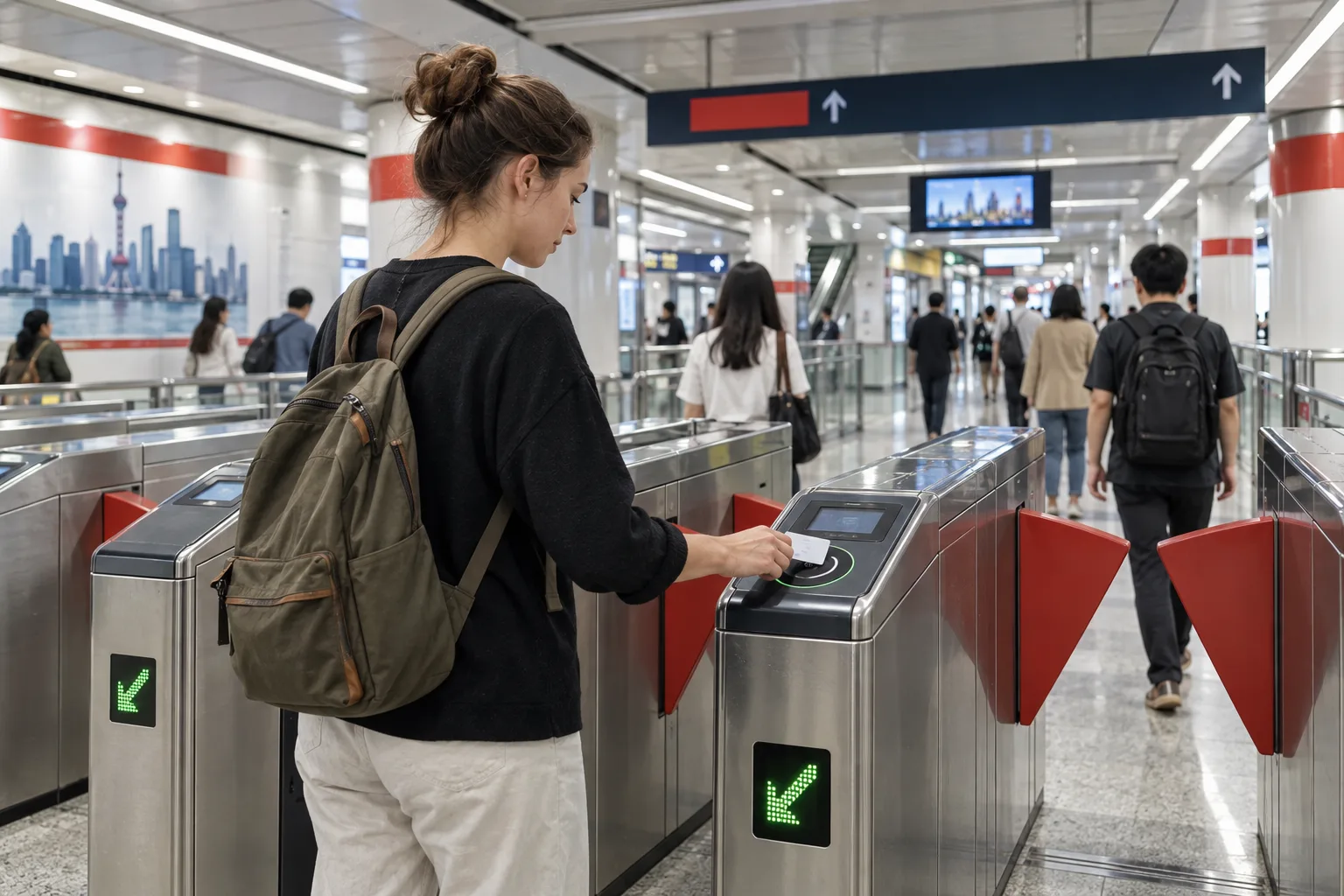
Eligible contactless UnionPay, Visa, Mastercard, American Express and JCB cards can be used for Tap to Ride. The card needs sufficient credit or balance and small-value password-free payment enabled. Look for the supported payment symbol on the gate and use the same payment method at entry and exit. Card issuer settings or an individual card may still prevent a transaction, so keep a backup.
A single-journey ticket is the low-setup fallback. Buy it for the destination shown on the machine or ask at the service center. Traditional IC-card and paper QR versions are valid only on the purchase day for one journey. They do not support leaving a station and continuing the same trip as an out-of-station transfer. Scan or insert the correct ticket type as indicated at the gate.
All metro-station service centers have card-payment terminals for ticket purchases, with the official city guide listing major overseas card networks. This is different from tapping a card directly at a fare gate: if the gate rejects a card, staff may still be able to sell a ticket through the service-center terminal.
For repeated rides, the Metro Daduhui app and the metro services inside Alipay or WeChat can generate a gate QR code. SH MaaS / Suishenxing offers an integrated code for metro, buses and ferries and supports international cards. Set up and test the service before a time-sensitive journey, and do not rely on a phone with a nearly empty battery.
Metro fares and whether a one-day or three-day pass is worth it
Checked September 21, 2026: Shanghai’s official visitor guide states that ordinary metro fares start at 3 yuan for journeys up to 6 kilometers, with 1 yuan added for each further 10 kilometers. When several transfer paths exist, the fare is based on the shortest route. Suburban railways opened in or after 2024 use a separate fare mechanism.
The published one-day metro pass costs 18 yuan and runs for 24 hours from first entry. The three-day pass costs 45 yuan and runs for 72 hours from first entry. Both allow unlimited metro rides during operating hours within their validity but exclude the Maglev and suburban railways opened in or after 2024. Confirm the current product and exclusions when purchasing.
A pass is useful for convenience only if it matches the actual itinerary. Compare it with the likely point-to-point fares rather than assuming unlimited travel automatically saves money. A day containing one neighborhood walk and one return ride may cost less with ordinary fares; a transfer-heavy day can make a pass more attractive.
There is also a Maglev and Metro Pass combining 24-hour metro travel with one or two Maglev journeys. It is a distinct product. The separate Shanghai Pass and special visitor products may include broader transport or attraction benefits, so read the name and exclusions carefully instead of asking only for a “Shanghai pass.”
- Single-journey ticket: useful for a simple ride without app setup.
- Contactless bank card: quick when the specific card and gate support it.
- Transport QR code: convenient for repeat travel after successful setup.
- One-day or three-day metro pass: compare the pass price with the rides you will actually take.
- Maglev, Airport Link and newer suburban rail: check separate ticket and fare rules.
How to plan a route and make a transfer without rushing
A useful route note has four parts: starting station, line number, travel direction and interchange station. The direction is normally shown by the terminal station, not by the name of your sightseeing destination. Recheck the platform sign before boarding, especially at stations where lines share a large concourse.
For a transfer, follow the color and line number signs inside the paid area. A route with fewer stops is not always the easiest route: one cross-platform change may be more comfortable than two long interchange walks. With children, luggage or reduced mobility, compare the number of transfers and walking distance as well as the estimated arrival time.
Do not exit through the fare gates unless the route specifically requires a new journey. Ordinary single-journey tickets do not support an out-of-station transfer. If a map recommends walking between two differently named stations, treat it as a surface connection and check whether a new fare is needed.
Save a screenshot of the route, station names and destination address. Mobile reception is generally useful underground, but a screenshot protects against an app refresh, low data or difficulty typing an English place name. At the destination, choose the exit closest to the exact building entrance rather than simply following the largest crowd.
Pudong Airport, Hongqiao and the Airport Link Line
Pudong International Airport and Hongqiao’s airport-and-railway hub can both appear in metro journey planners, but airport travel deserves more buffer than a normal sightseeing ride. Confirm the airport code, terminal and station before leaving. Hongqiao Airport Terminal 1 and Terminal 2 do not use identical metro access, and Pudong Airport covers a large terminal area.
Metro Line 2 is a city-crossing option linked with Pudong Airport and the Hongqiao transport hub. The Maglev is a separate train between Pudong Airport and Longyang Road rather than a direct train to the Bund or most hotels. A Maglev journey may still require a metro or road transfer at Longyang Road.
The Airport Link Line is also separate from the ordinary metro fare structure. The official city guide lists fares from 4 yuan to 26 yuan and describes the airport-to-airport journey as about 40 minutes. Use its current timetable and station access information; “airport link” does not mean it stops at every central hotel district.
For an early departure, late arrival, several large bags or a traveler who cannot manage a long interchange, compare a reserved car or taxi with the rail route. Never use an average train time as the entire hotel-to-check-in estimate. Add the hotel-to-station walk, security check, waiting, transfers and the final walk to the airline area.
Luggage, security checks and station storage
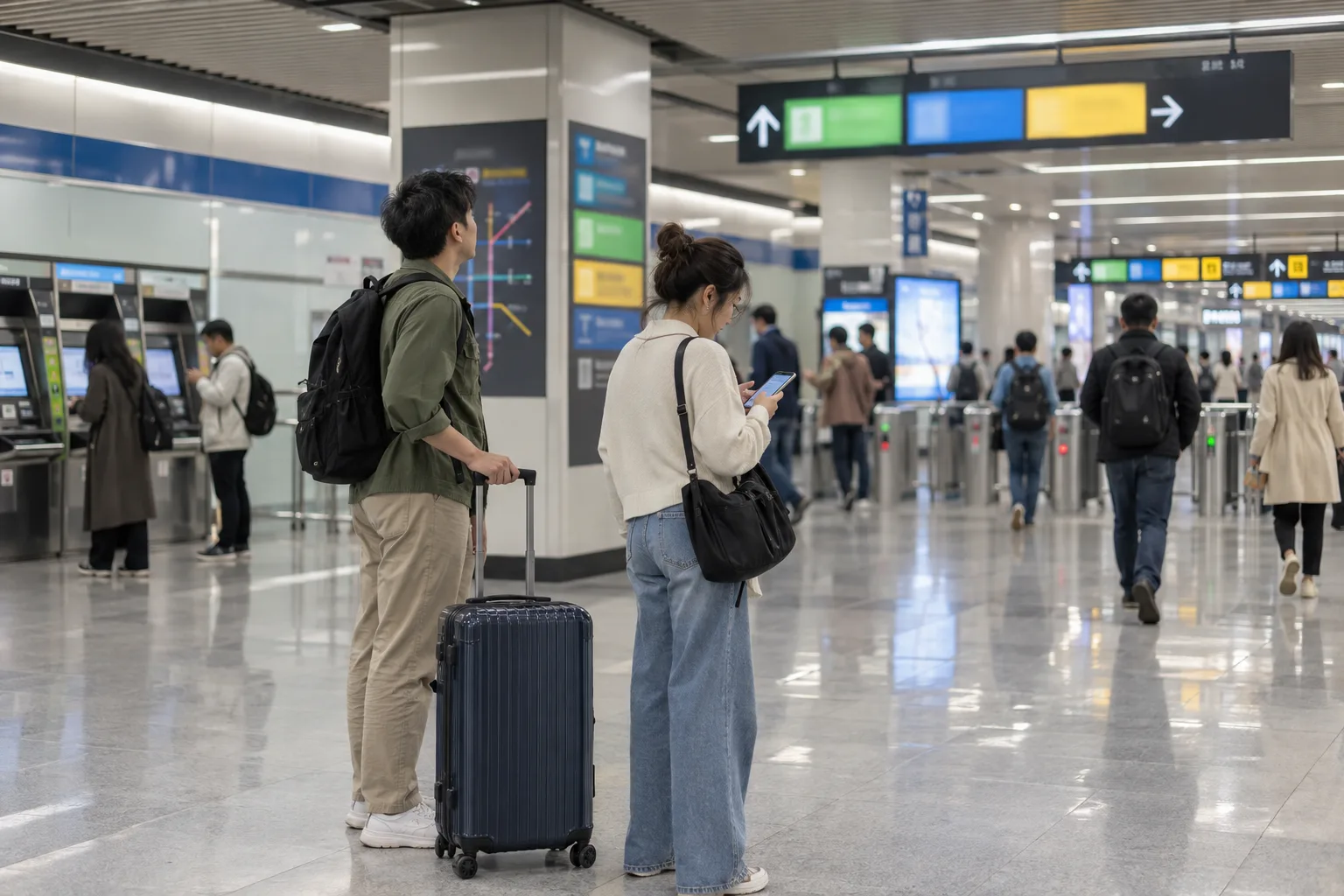
Security screening is a routine part of Shanghai metro travel. Allow time to place bags through the scanner and follow staff instructions. Dangerous, flammable, explosive, toxic, radioactive and corrosive items are prohibited. Official guidance also restricts badly packaged sharp or fragile objects, strongly odorous items, bicycles, inflatable balloons and animals other than guide and police dogs.
The official rule also sets limits for very heavy or oversized items, including a total length-plus-height-plus-width threshold of more than 1.8 meters. Travelers with unusually large sports equipment, exhibition cases or multiple oversized bags should check the current rule before reaching the station. A standard suitcase may be permitted but can still make stairs, narrow gates and busy platforms difficult.
Shanghai Metro offers self-service luggage storage at participating stations. The official Metro Daduhui app can show locations and real-time availability. Storage only operates within station operating hours; it is not a guaranteed overnight service or a reason to leave too little time before the final train.
Keep the suitcase beside you and out of the passenger flow while checking a phone. Use elevators where available and ask staff for the wide gate rather than forcing baggage through a narrow lane. During peak commuting periods, a car transfer may be worth the cost if luggage would make several metro changes stressful.
First and last trains, accessibility and a reliable backup
Operating times vary by line, station, direction and date. Check the first or last train for the exact station and direction in the official metro service on the travel day. A system-wide closing time is not a safe planning shortcut, and a late arrival at an interchange does not guarantee the connecting line is still running.
If the last train matters, plan an earlier target and save a road-transport backup. Late-evening service changes, maintenance, crowd controls and holiday arrangements can affect a familiar route. The same principle applies to major events: follow station instructions rather than insisting on the exit or transfer shown in an old screenshot.
Travelers needing step-free access should check elevators for the specific entrance, platform and exit. An accessible gate does not prove that the whole surface route to a hotel or attraction is step-free. Avoid the busiest commute window where possible, and ask station staff when an elevator or accessible path is unclear.
A hotel card or destination address in Chinese is the most useful backup if the metro plan fails. Keep enough battery and a second payment method. For a time-critical airport, railway or cruise transfer, choose the option with a manageable number of hand-offs rather than the route that saves a few yuan on paper.
Practical questions
Can foreign visitors tap a bank card on the Shanghai Metro?
Eligible contactless UnionPay, Visa, Mastercard, American Express and JCB cards can support Tap to Ride. The card needs sufficient funds and small-value password-free payment enabled. Check the gate symbol and keep another payment method in case the individual card is declined.
How much does the Shanghai Metro cost?
The official visitor guide updated in 2026 lists ordinary metro fares from 3 yuan for up to 6 kilometers, then 1 yuan for each additional 10 kilometers. Newer suburban rail services have separate fare rules.
How much are Shanghai one-day and three-day metro passes?
The published prices checked September 21, 2026 are 18 yuan for 24 hours and 45 yuan for 72 hours from first entry. They exclude the Maglev and suburban railway lines opened in or after 2024; confirm current terms when buying.
Does a Shanghai Metro pass include the Maglev or Airport Link Line?
Ordinary one-day and three-day metro passes do not include the Maglev or newer suburban railways. The Airport Link Line has a separate fare mechanism. A combined Maglev and Metro product is sold separately.
Can I take large luggage on the Shanghai Metro?
Normal luggage is commonly carried, but security screening and size or weight restrictions apply. Very large bags also make transfers and peak-hour travel difficult. Check current rules and consider a road transfer when handling several heavy cases.