What “Shanghai French Concession” means for a city walk
“Shanghai French Concession” is a widely used travel search term for a broad historical area west and southwest of the old city. It is not a present-day administrative district with one gate, one ticket or one official walking boundary. Today the streets cross parts of Xuhui and Huangpu districts, and the most rewarding experience comes from choosing one connected route instead of trying to cover every famous road in a single outing.
The appeal is also different from the Bund. Here the city reveals itself at walking speed through plane-tree canopies, apartment facades, garden villas, small parks, neighborhood shops and layers of twentieth-century urban history. Some buildings are private residences, offices or controlled venues. A good walk reads their exterior and street setting without assuming that every historic doorway is open to visitors.
For a first walk, use the western Wukang–Anfu area as the opening chapter and decide whether to continue east toward Fuxing Park and Sinan Mansions. The full connection is longer than it looks on a map once photographs, crossings, coffee and architectural stops are included. Most travelers will enjoy either a two-hour western loop or a four-to-five-hour west-to-east walk more than an exhausting attempt to “finish” the whole former concession.
- Two hours: Wukang Mansion exterior, Wukang Road and Anfu Road.
- Half day: add selected Hengfu streets and finish near a convenient metro or lunch stop.
- Long half day: continue to Fuxing Park and Sinan Mansions with a proper rest break.
Best starting route: Wukang Mansion, Wukang Road and Anfu Road
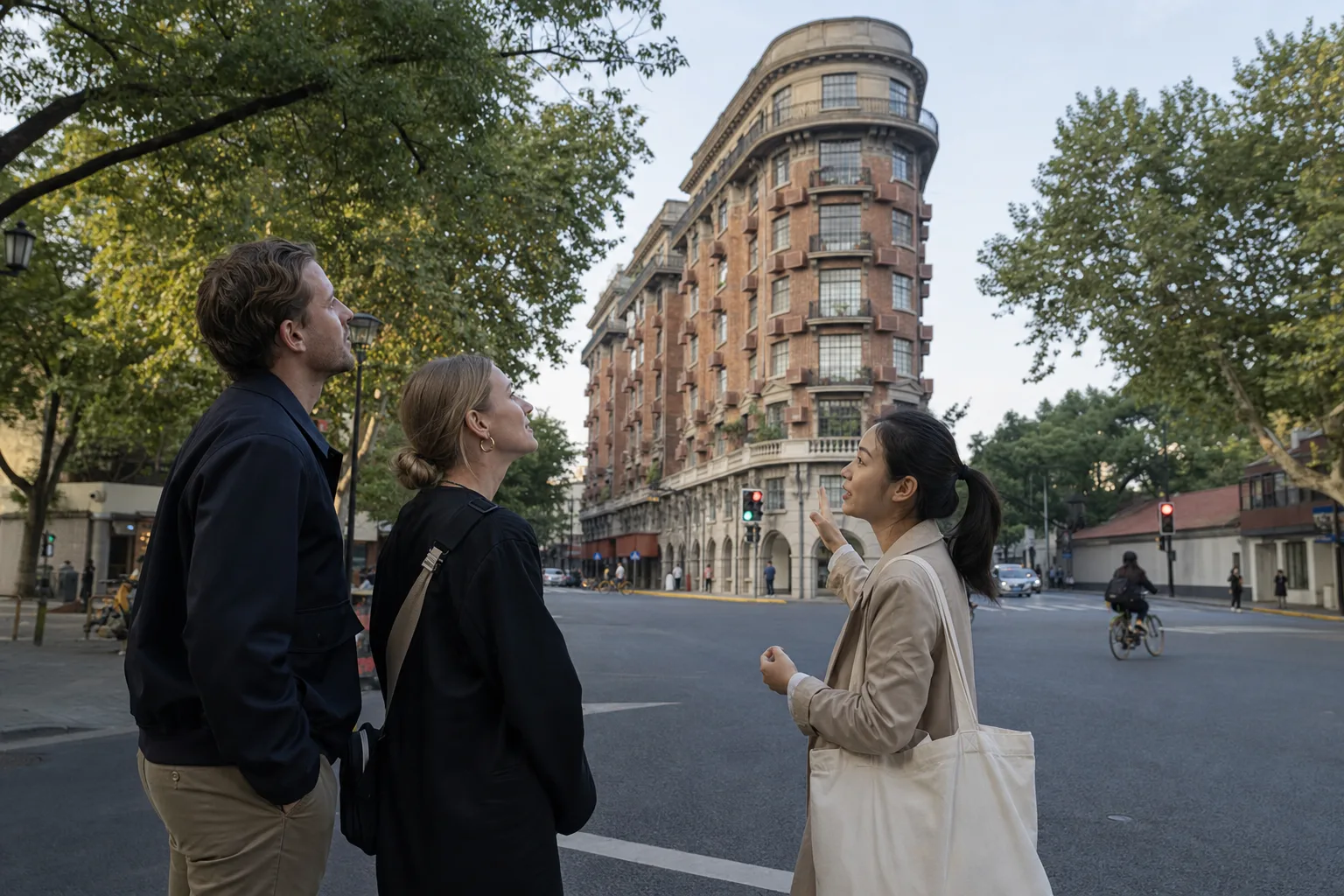
Begin outside Wukang Mansion at the junction of Huaihai Middle Road and Wukang Road. The former Normandy Apartments were completed in 1924 and designed by architect László Hudec. Its narrow, ship-like form makes it a clear orientation point, but the intersection is active and the building is not simply a public interior attraction. Take exterior photographs from a safe legal position, keep entrances clear and move into the quieter street rather than spending the whole morning around one facade.
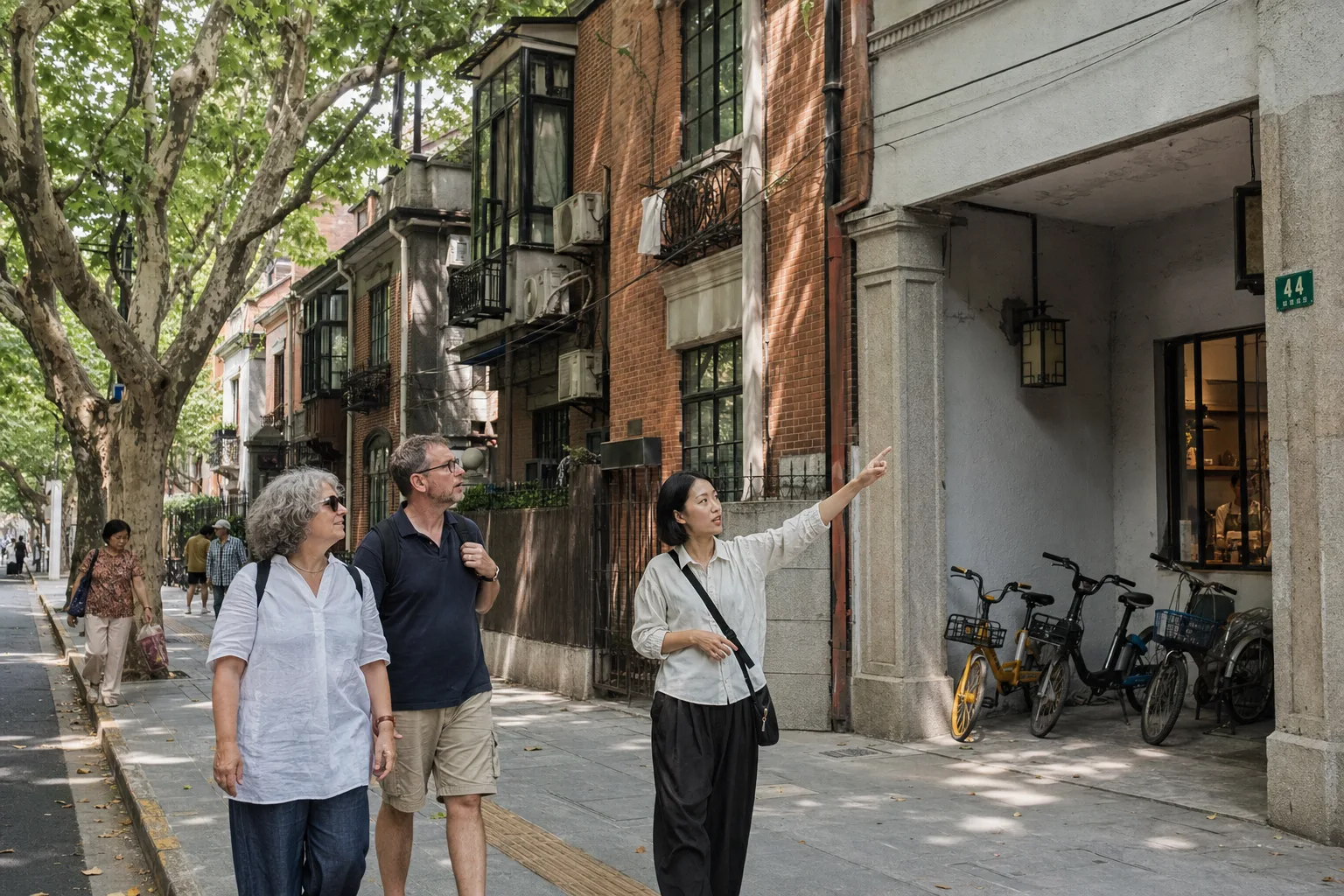
Walk north on Wukang Road slowly. Official Shanghai visitor information describes the road as a concentration of varied historic architecture and former residences, which is exactly why a guide or a little preparation adds value: otherwise attractive facades can blur together. Notice how setback, garden wall, apartment scale and street trees change from block to block. The objective is not to photograph every former home; it is to understand how residential Shanghai developed beyond the riverfront business district.
Turn toward Anfu Road for a livelier contrast of cultural venues, cafes, neighborhood retail and everyday foot traffic. The Wukang–Anfu block is popular and can become crowded around photogenic corners, particularly on weekends. Keep the group compact, avoid blocking bicycle lanes and shop entrances, and treat a cafe as a planned rest rather than another box to tick. Allow roughly two to three hours for this western section when you want explanation and photographs, or about ninety minutes for a purposeful independent walk without long indoor stops.
Extend through the Hengfu historic area without chasing every address
If the group still feels fresh, continue through selected streets in the Hengshan–Fuxing, or Hengfu, historic area. Fenyang Road, Yueyang Road, Hengshan Road and sections of Fuxing Middle Road can reveal music institutions, educational buildings, residential compounds and shaded streets, but they do not form one compulsory line. Choose the connection that fits your finish point and the places actually open on the date.
Shanghai’s official city-tour material presents Hengfu as a heritage area with historic buildings and a strong musical layer. A recent official walking route in Xuhui covers about 2.5 kilometers, which is useful evidence that a focused thematic walk can be satisfying without crossing the whole historical concession. Your own distance will vary because hotel location, temporary works, venue access, heat and the time spent at each exterior all change the route.
This middle section is where an itinerary often becomes too ambitious. Do not add a distant restaurant, museum and every landmark between Wukang Road and Fuxing Park merely because the map shows them in the same broad area. Pick one cultural theme—architecture, music, neighborhood life or food—and let the other details support it. If the group is already tired, finish the western walk well and reach the next destination by metro or car rather than turning the final hour into a forced march.
Use Fuxing Park as a local-life pause, not a rushed photo stop
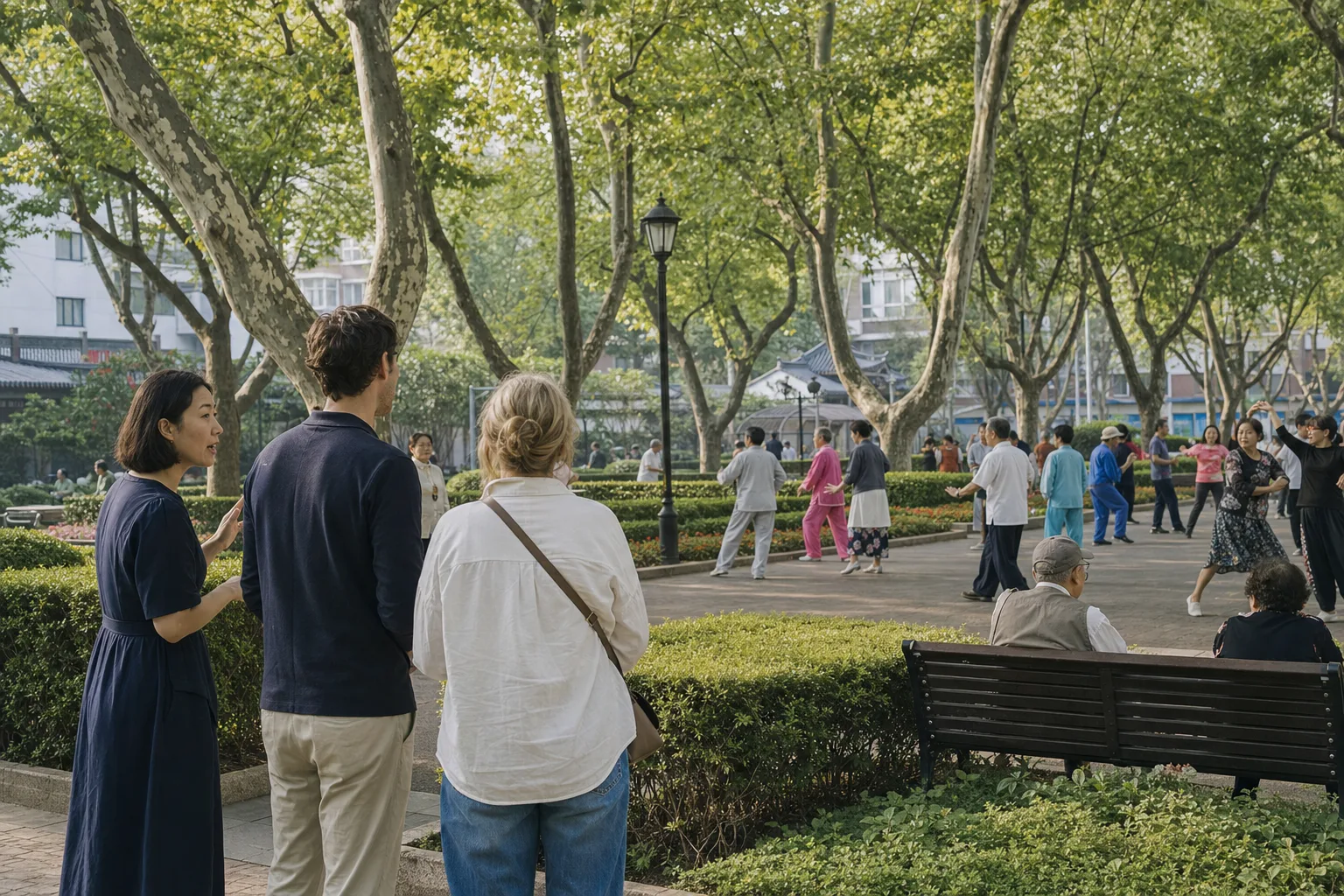
Fuxing Park changes the rhythm from facades to public life. In the morning, visitors may encounter residents exercising, dancing, singing, playing music or meeting friends. These activities are not scheduled performances for tourists, so watch with courtesy, keep a reasonable distance and ask before taking close photographs of identifiable people. The experience is valuable precisely because it is ordinary city life rather than a staged attraction.
The park’s axial layout, lawns and garden elements also provide a useful break from pavement. Current official information lists Fuxing Park as free and open daily from 5 am to 9 pm, but opening arrangements can change and should be checked close to the visit. Early morning offers more local activity and softer summer temperatures; later in the day, the park works as a shaded rest between the Hengfu streets and Sinan Mansions.
Allow thirty to sixty minutes depending on energy and interest. A bench stop and water break are part of good route design, not wasted time. If heavy rain, extreme heat or a mobility concern makes the park uncomfortable, shorten the loop and protect the next indoor or vehicle connection instead of insisting on every path.
Finish around Sinan Mansions and the surrounding garden-villa streets
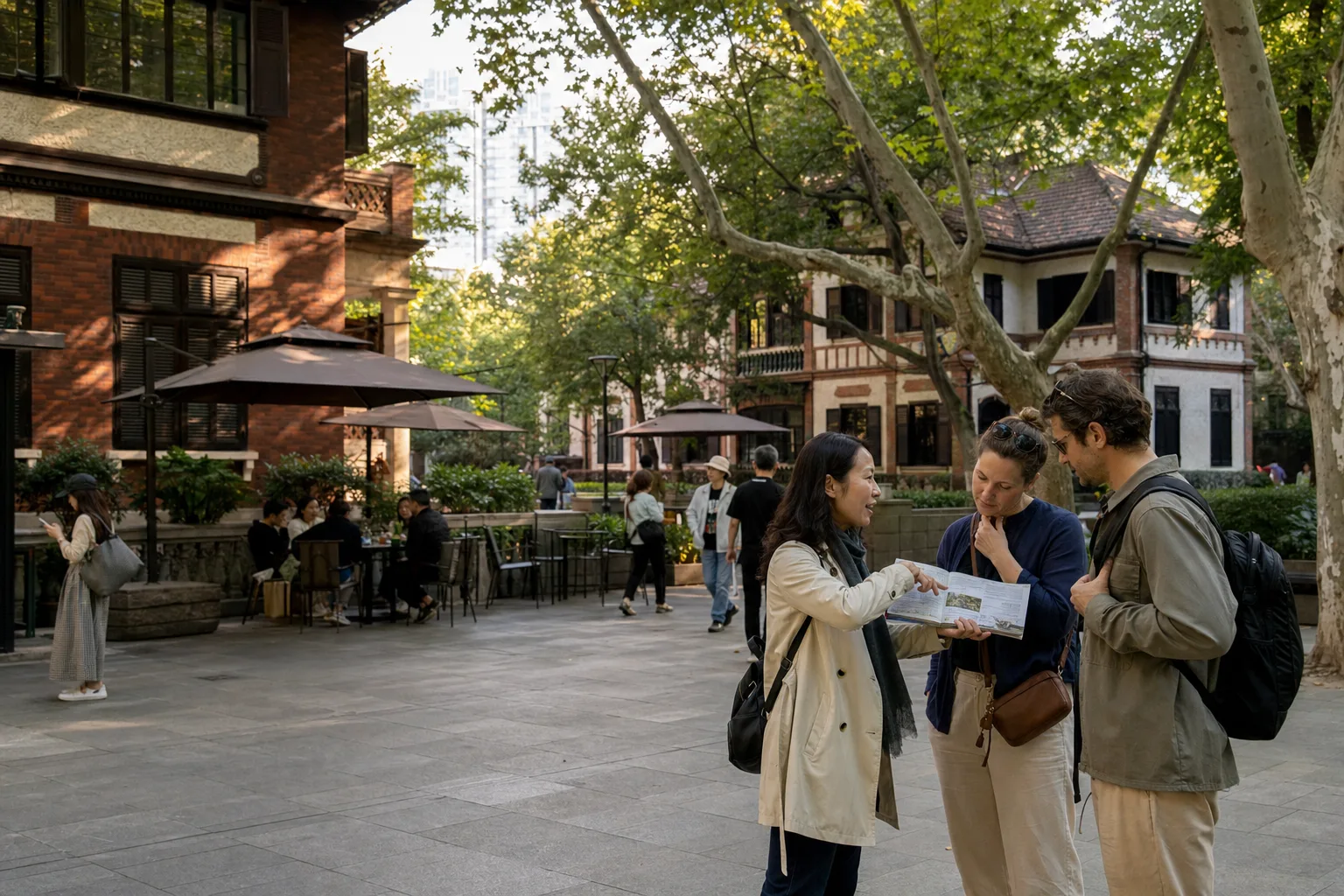
Sinan Mansions provides a natural eastern finish because its preserved garden-villa environment feels different from the apartment streets around Wukang Road. Official destination information describes a protection and renovation area with a complete cluster of garden-style villas and public urban space. Walk the public passages, compare building types and use the cafes or restaurants when they suit the group; do not interpret a historic exterior as permission to enter a residence or restricted courtyard.
This is also a sensible place to end for lunch or a late-afternoon pause. From here, travelers can continue toward Xintiandi, return to the hotel or connect to another appointment. The day remains stronger when Sinan Mansions is the final chapter rather than the beginning of another long checklist across the old city and Bund.
If your priority is photography, arrive with enough light but remain aware that these are lived-in and commercially active streets. Use modest equipment, avoid photographing directly through residential windows, and do not occupy narrow entrances for posed shoots. Respectful behavior produces a calmer visit and reduces friction for residents who encounter visitors every day.
Choose the right walking length for your day
A compact route is not an inferior route. The best version depends on weather, hotel position, walking confidence and what comes before or after. Distances shown by a map do not include building interpretation, street crossings, detours, queueing or the time needed to find a legal vehicle pickup point.
- Two-hour western walk: start at Wukang Mansion, continue along Wukang Road and finish around Anfu Road. Best for a first taste, hot weather or an afternoon with another fixed booking.
- Half-day architecture walk: use the western route, add selected Hengfu streets and finish with lunch or metro access. Best for travelers interested in buildings and neighborhood history.
- Long half-day west-to-east walk: connect Wukang–Anfu, selected Hengfu streets, Fuxing Park and Sinan Mansions. Build in a cafe or lunch break and expect four to five hours rather than reading the straight-line distance.
- Low-walking version: use a vehicle between two compact zones, such as Wukang–Anfu and Fuxing Park–Sinan Mansions. Shorten each walking loop and confirm seating and step concerns in advance.
Practical walking advice for heat, rain and busy streets
Wear shoes that are comfortable on uneven pavement and carry water in warm weather. Shanghai summers can be humid, while winter shade and wind make long outdoor stops surprisingly cold. A light rain layer is often more useful than an umbrella on a crowded sidewalk. Plan a real indoor pause during hot or wet conditions, and move the most exposed section to the most comfortable part of the day.
Public toilets are easier to find around parks, metro stations, malls and larger cultural venues than on every residential block. Use them before beginning the longest street section. Independent travelers should keep mobile mapping available and save the hotel address in Chinese. Metro is efficient for reaching the broader area, while ride-hailing or a private car can help at the beginning and end; neither removes the need to walk from legal stopping places.
The route mixes sightseeing streets with real residential movement. Stand clear of bicycle lanes, look carefully when crossing side roads and avoid walking four abreast. Keep voices low in residential lanes, ask before photographing people at close range, and never enter a private compound because a door happens to be open. These small habits matter more here than speed.
When a private guide or car improves the walk
A guide is most useful when the group wants to understand architectural layers, connect places without constant map checking, or adapt the route for children, senior travelers or a specific historical interest. The benefit is interpretation and pacing, not access to private interiors. Ask what will be explained, which public or ticketed interiors are actually planned, and how the route changes if a venue is closed.
A private car helps when the walk is combined with the Bund, Pudong, an airport or a distant hotel. For the neighborhood itself, a car will normally use selected pickup points while the group walks between them. Confirm the pickup road, expected walking sections and return deadline before the day. In a one-day private tour, the former French Concession should be one meaningful neighborhood chapter rather than a hurried transfer between several unrelated photo stops.
Before requesting a tailored route, send the hotel, date, comfortable continuous walking time, traveler ages, fixed bookings and the main interest—architecture, photography, food or local life. That information allows the guide to choose a focused route that remains enjoyable even if weather or access changes.
Practical questions
How long should I allow for a Shanghai French Concession walk?
Allow about two hours for a focused Wukang–Anfu walk, three to four hours for a deeper western and Hengfu route, or four to five hours with a proper break when continuing to Fuxing Park and Sinan Mansions.
Where is the best place to start the walk?
Wukang Mansion is a clear western orientation point for first-time visitors. Continue along Wukang Road and Anfu Road, then decide whether energy and weather support an eastward extension.
Is the former French Concession free to visit?
The streets and public spaces are generally free, and current official information lists Fuxing Park as free. Individual museums, exhibitions, gardens, cafes or controlled historic interiors can have their own tickets and opening rules.
Is this walk suitable for senior travelers or children?
Yes when the route is shortened, restrooms and seating are planned, and a vehicle is used between compact zones if needed. Share continuous walking limits, stroller needs and step concerns before fixing the route.
Do I need a guide for Wukang Road and the former French Concession?
No. Independent travelers can use metro and mapping, but a guide can add architectural context, connect the streets efficiently and adjust the pace without implying access to private buildings.